
The Missing Ledger:
Exposing Operational Risk as Measurable Exposure
Why Clean Audits Precede Catastrophic Failures
“Financial reports as a proxy for the truth have lost their currency. We are accounting for the past while the future collapses.”
Most institutions still manage operational risk through subjective scoring and backward-looking loss views. Heatmaps and conventional RCSAs don’t behave like numbers: they cannot be aggregated into a portfolio, compared across business lines, or used to justify mitigation investment with measurable impact. Conventional risk frameworks suffer from three systemic flaws:
The Aggregation Flaw (Color Math Doesn’t Work)
Operational risk is the only banking discipline managed by traffic lights. You cannot add “Red” from Payments to “Amber” from Lending to calculate total enterprise exposure. Colors cannot be summed.
The Backward-Looking Blind Spot
Loss-event databases are purely retrospective—a rearview mirror. They record failure only after capital has already been destroyed, detached from current business volume or surging product complexity.
Disconnected by Design (The Dark Exposure Gap)
Risk is created the moment a transaction is executed in the General Ledger. Yet it is reported weeks or months later via subjective surveys. In that gap lies undetected exposure accumulation.
The Risk Accounting Engine: How It Works
RiskoMetrics bridges the gap between Andrew Lo’s demand for a risk-sensitive balance sheet and Peter J. Hughes’ empirical invention of the Risk Unit (RU). By attaching an auditable shadow ledger of RUs to operational transaction throughput, non-financial risk becomes measurable exposure that obeys rigorous arithmetic.
Inherent Risk (RU) = EUF × VBW
[Exposure Uncertainty Factor × Value-Based Weighting]
Risk Mitigation Index (RMI) = Quantified Control Effectiveness (0–100%)
Residual Risk (RU) = Inherent RU × (100% − RMI)
VBW (Value-Based Weighting): Scales inherent exposure with operational volume and asset throughput.
Residual Risk: The net risk burden carried by the institution. A higher RMI directly reduces the capital-at-risk burden.
A Unified Exposure Language Across the Enterprise
RiskoMetrics aligns operations, risk, finance, and leadership around a single measurement system, replacing subjective debate with quantitative portfolio governance.
1st Line Operations
Connect daily transaction volume directly to operational exposure. Control hygiene improvements immediately increase RMI and lower Residual Risk, returning clear operational risk ownership to the business unit.
Explore Operations Visibility →
Risk u0026 Compliance
Replace subjective surveys with data-backed challenge. “Green” is no longer an opinion or a political negotiation; it is an auditable, evidence-based score supporting Basel Committee standard BCBS 239 (Risk Data Aggregation and Reporting) and Operational Resilience requirements.
Explore Risk & Compliance →
Heads of Finance
Connect non-financial exposure directly to financial cost logic: Economic Profit = GAAP Profit − Valued Expected Loss. Justify control investments with clear residual risk reduction ROI.
Explore Finance Integration →
Management u0026 Boards
Aggregate disparate business lines on a single objective dashboard (e.g., Retail Banking 1,200 RU vs. Derivatives 850 RU). Govern risk appetite with explicit numeric limits in RUs rather than ambiguous qualitative policy statements.
Explore Board Governance →
From Reporting Losses to Designing Trust
When exposure is measurable and mitigation is numeric, governance becomes calmer, more rigorous, and defensible. You can justify control investments by measurable residual reduction—and operational efficiency becomes a natural dividend of reducing risk accumulation.
Make Risk Governable
Stop debating colors. Start governing numbers.
Security, Privacy & Data Integrity Built for Regulated Institutions
Designed for financial institutions and critical infrastructure: strong authentication, cryptographic data integrity, logical tenant isolation, and privacy-first processing of uploaded transaction datasets.
Data Integrity u0026 Immutability
Calculation logs, parameter configurations, and assessment inputs are immutably recorded, preventing retroactive gaming and ensuring full audit readiness for regulators.
Zero PII Exposure
Throughput analysis operates strictly on numeric financial volume, transaction counts, and product metadata—requiring zero personally identifiable customer data.
Tenant Isolation u0026 Role-Based Access Control (RBAC)
Segregated data models, encrypted transport (TLS 1.3), and strict Role-Based Access Control enforcing cryptographic separation of duties between 1st Line and 2nd Line.
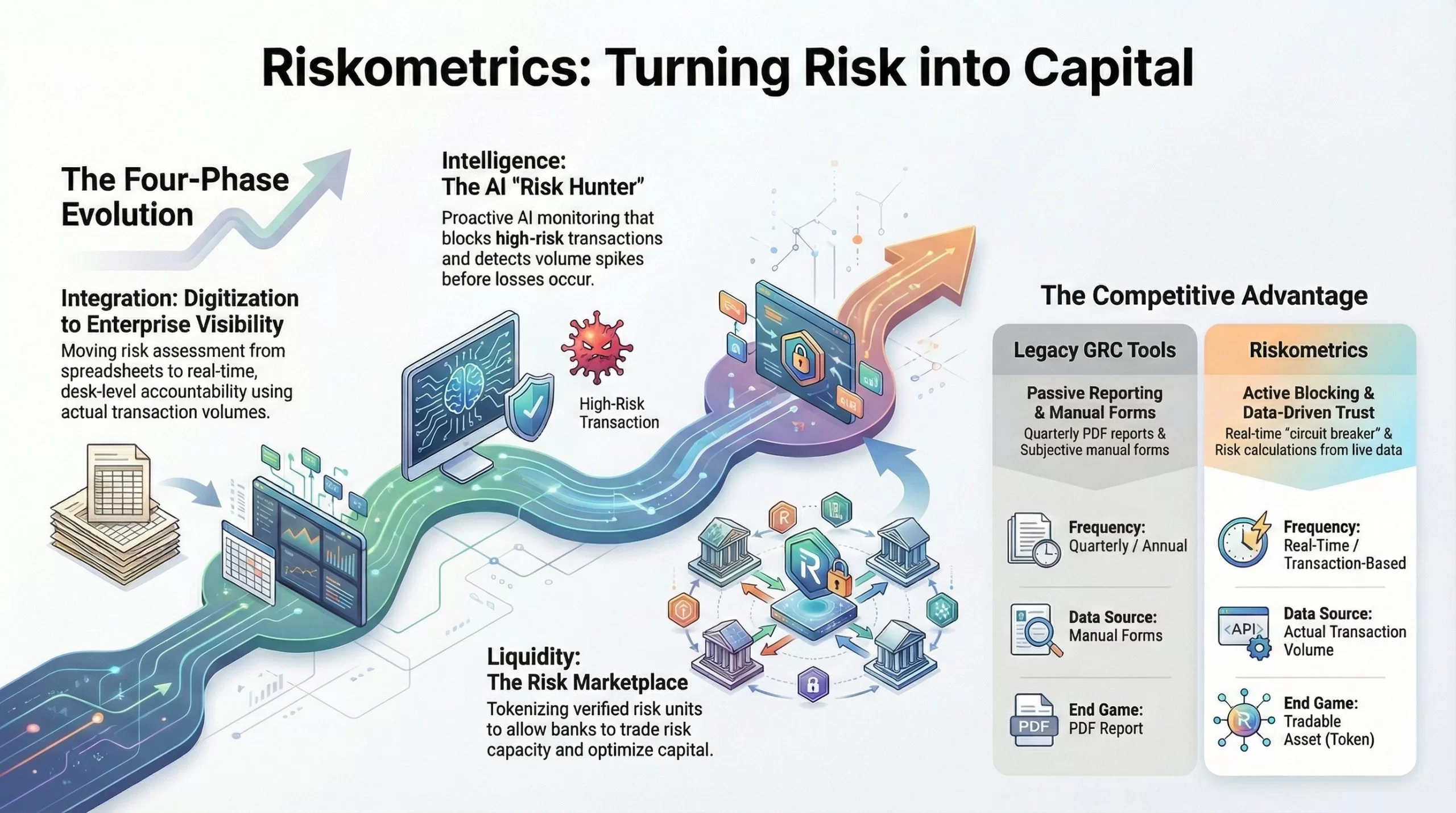
The Evolution of Risk: From Compliance Burden to Asset Optimization
Start with measurable exposure in a controlled diagnostic pilot. Expand into enterprise workflow operationalization, automated AI risk hunting, and a liquid marketplace for risk transfer.
Phase 1: Digitization (Access Edition)
[Available Now]
Single-user diagnostic demonstrator. Fast onboarding: quantify inherent exposure from transaction flow, run Enhanced Risk and Control Self-Assessments (E-RCSA), and establish an initial baseline.
View Access Roadmap →
Diagnostic Pilot u0026 Workbench
[Available Now]
Dedicated multi-tenant pilot environment accessible for validation and proof-of-concept projects. Test controlled transaction datasets with team access.
Access Pilot Platform →
Phase 2: Operationalization (Enterprise Edition)
[Coming Soon]
Institutional hierarchy integration: mapping RUs to specific desks, branches, and shared services. Direct integration with core banking General Ledgers and enterprise Governance, Risk, and Compliance (GRC) platforms.
View Enterprise Roadmap →
Phase 3: Intelligence (AI Risk Hunter)
[Coming Later]
Autonomous active monitoring: detecting volume velocity surges, missing control assessments, and enforcing operational risk limits before losses materialize.
View AI Hunter Roadmap →
Phase 4: Liquidity (Risk Marketplace)
[Long-Horizon Vision]
Tokenization of risk assets into Tradable Risk Units (TRUs): creating a liquid, benchmarkable market for non-financial risk distribution and insurance optimization.
View Marketplace Roadmap →
Validate the Methodology in a Controlled Pilot
You can register your user account today on Access Riskometrics.
- Phase 1 — Method Orientation: Select a candidate product family and map its supporting business components and uncertainty factors (EUF).
- Phase 2 — Diagnostic Pilot: Upload a controlled transaction dataset into RiskoMetrics Access to compute initial product-level Inherent RUs, run E-RCSA, and calculate RMI and Residual RUs.
- Phase 3 — Enterprise Readiness: Evaluate integration pathways into core General Ledger pipelines, GRC systems, and board governance limits.